

There's a common sequence of events in growing businesses: the team gets busy, someone can't keep up, so you hire another person to help. The new hire learns the process - including all its manual steps, workarounds, and institutional quirks - and the cycle continues.
What rarely happens: stopping to ask whether the process itself should exist in this form.
The cost scales with headcount
A manual process that costs one person two hours a week costs five people ten hours a week. That's not a metaphor - it's arithmetic. When you hire into a broken process, you're not solving the problem, you're funding it.
The same applies to errors. A process that generates one mistake per fifty executions generates ten mistakes per day when you scale to higher volume. More people don't fix the underlying fragility - they distribute it.
What automation actually does
Automation, when done right, doesn't replace people. It also removes the parts of work that shouldn't require doing in the first place: moving data between systems, generating routine reports, sending follow-up emails at the right time, routing incoming documents to the right place.
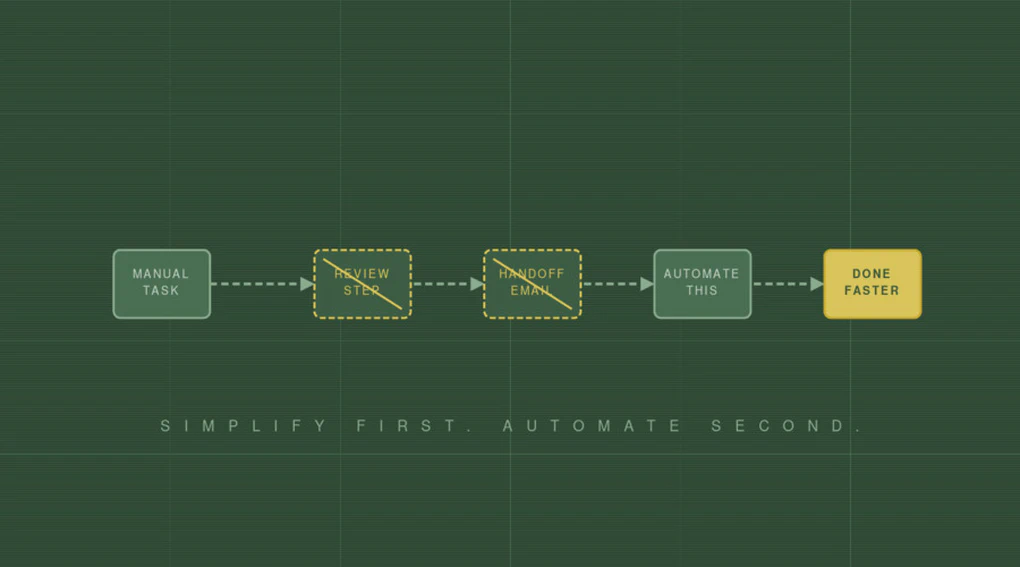
It starts with simplifying - are those steps even needed? Can we skip them entirely? Only do them when something exceptional happens? Only then automate.
When those tasks are automated, the people on your team spend their time on work that requires judgment, relationships, and context — the things that actually justify the hire.
The right order
Hire first, automate later is expensive. You pay for the person, you pay for their time on the manual process, and eventually you pay to retrain them when you finally automate it.
Simplify and automate first, hire second gives you something cleaner. When the next person joins, they step into a system that works. Their time goes to the high-value work immediately. The manual overhead doesn't come with them.
A practical test
Before your next hire, you should map what that person will actually spend their time on. How much of it is moving information from one place to another? How much is generating the same report in a slightly different format? How much is chasing confirmations?
If the answer is "quite a bit," that's not a hiring problem — it's an automation opportunity.
The hire might still be the right call. But automating first means you hire for capacity and judgment, not to fill the gap left by a process that shouldn't exist the way it does.
One more thing
Automating before you hire also means you know what the process should look like before you try to explain it to someone new. Documentation and automation often solve the same problem: making implicit knowledge explicit. That clarity has value beyond the automation itself.
If you're not sure where to start, a structured workflow audit can surface the highest-value opportunities in two weeks — before you've committed to a new headcount budget.